

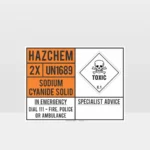
 Sodium Cyanide Solid... Price range: $13.50 through $149.95 exc. GST
 Petroleum Distillate... Price range: $13.50 through $149.95 exc. GST
Sodium Hypochlorite Emergency Information Panel Sign
Price range: $13.50 through $149.95 exc. GST
HAZCHEM Sign – Sodium Hypochlorite Emergency Information Panel Sign
The “Sodium Hypochlorite Emergency Information Panel Sign” – ensures that personnel, visitors, and emergency responders are well-informed about the chemical’s hazards and proper safety protocols, minimizing risks to health and safety and allowing for a quick, effective emergency response.
- Standard sizes available 300mm x 225mm, 450mm x 337mm, 600mm x 450mm, 900mm x 600mm 1200mm x 800mm.
- Laminated
- Supplied as an adhesive vinyl sticker or mounted on corflute, PVC, Magnetic material or ACM panel
- Meets industry standards when used appropriately
- 300 × 225 mm — Close-range / supplementary (≈≤5 m, not suitable for 10 m)
- 450 × 337 mm — Minimum for ~10 m viewing
- 600 × 450 mm — Recommended (10–15 m)
- 900 × 600 mm — Yard / gate (15–20 m)
- 1200 × 800 mm — Roadside / long approach (25–30 m)
This one’s no ordinary “bleach warning” – it’s your frontline defence against nasty mix-ups!
If you’re dealing with strong cleaning chemicals, you’ll also want to check out our Phosphoric Acid Solution Emergency Information Panel Sign – perfect for other Class 8 corrosive applications.
Sodium Hypochlorite Emergency Information Panel Sign
Sodium Hypochlorite Emergency Information Panel Sign – The Sodium Hypochlorite Emergency Information Panel (EIP) Sign plays a critical role in safety and emergency response in settings where sodium hypochlorite (commonly found in bleach) is stored, handled, or transported. Its key purposes include:
- Chemical Identification: The “Sodium Hypochlorite Emergency Information Panel Sign” identifies the presence of sodium hypochlorite, a powerful oxidizing agent and disinfectant. This ensures that personnel and emergency responders are aware of the specific chemical in use, enabling them to take appropriate safety measures.
- Hazard Communication: It informs about the specific risks associated with sodium hypochlorite, such as:
- Corrosiveness: Sodium hypochlorite can cause irritation or burns upon contact with skin and eyes, and inhaling its vapors can lead to respiratory issues.
- Reactivity: It reacts violently with acids, releasing toxic chlorine gas. It can also react with organic materials and certain metals, creating hazardous conditions.
- Safety Precautions: The panel outlines important safety measures to prevent accidents, such as:
- Using appropriate personal protective equipment (PPE) like gloves, goggles, and protective clothing to avoid direct contact with the chemical.
- Ensuring proper ventilation in areas where sodium hypochlorite is used to prevent inhalation of harmful vapors.
- Storing sodium hypochlorite away from acids, ammonia, and other incompatible substances to avoid dangerous chemical reactions.
- Emergency Response Instructions: In case of an accident, spill, or chemical exposure, the sign provides clear instructions on how to respond safely, including:
- Evacuating the area if toxic chlorine gas is released.
- Containing and neutralizing spills using appropriate absorbents and avoiding water for large spills, which can spread the chemical.
- Firefighting measures, as sodium hypochlorite is not flammable but can decompose under heat, releasing oxygen and intensifying a fire.
- Health and First Aid Procedures: The sign includes essential first aid steps in case of exposure, such as:
- Flushing skin or eyes with water in the event of contact to minimize chemical burns.
- Moving to fresh air immediately in case of inhalation of vapors, and seeking medical attention if symptoms like coughing or difficulty breathing occur.
- Avoiding ingestion and seeking immediate medical help if swallowed, as sodium hypochlorite is harmful if ingested.
Specialist Advice Field – What To Add
On all Emergency Information Panel (EIP) Signs, there is a section labelled “Specialist Advice”. This is where you can add contact details for immediate technical or emergency response advice.
For example, you can include:
-
Company emergency phone number (e.g. 0800 XXX XXX)
-
On-site chemical specialist or health & safety officer contact
-
Emergency response contractor details (e.g. CHEMCALL, if your company is subscribed, or another provider)
-
Internal HSE department contact
👉 If you don’t have a specialist service, you can still include a company name and phone number so first responders know who to contact immediately.
NOTE: If you wish to use 0800 CHEMCALL, please note that this service is operated by Responsible Care NZ and permission/approval must be obtained directly from them prior to use.
The Sodium Hypochlorite Emergency Information Panel Sign displays UN 1791, HAZCHEM 2X, packing group and emergency contacts — essential for pool chemical storage, water treatment facilities, cleaning chemical suppliers, dairy plants, sanitation systems, and industrial disinfection operations.
To understand when these signs are required and how each field must be filled out correctly, check our guide:
➡️ Emergency Information Panel Signs Explained
Handling bleach on an industrial scale? Best get the signage sorted — because one spill of the strong stuff and suddenly everyone starts smelling “hospital clean” whether they like it or not.
For another corrosive liquid commonly stored alongside bleach, also see our:
➡️ Nitric Acid EIP Sign
Sodium hypochlorite is a Class 8 Corrosive that releases chlorine gas when mixed with acids — making correct segregation, labelling, and emergency details critical. Learn how corrosives fit within NZ’s Dangerous Goods framework in:
➡️ Understanding Dangerous Goods Classes 1–9
The 2X HAZCHEM code tells responders that fine water spray may be used, but full protective clothing is required and atmospheric precautions must be taken due to possible toxic gas release.
See how to interpret all HAZCHEM codes used in NZ & Australia here:
➡️ Understanding HAZCHEM Signs in New Zealand & Australia
FAQs
1. Why do I need a Sodium Hypochlorite EIP sign?
Because this chemical can react violently with acids, ammonia, and other reducing agents, releasing toxic chlorine gas. The sign ensures compliance with NZ Dangerous Goods regulations and allows emergency crews to identify the hazard class quickly and act safely.
2. Where should it be displayed?
Use on tankers, drums, or facility entrances storing or transporting sodium hypochlorite solution.
-
Minimum size: 600 × 450 mm (roadside visibility ≈ 10–15 m)
-
Preferred size: 900 × 600 mm or larger for bulk transport or long-distance viewing
3. What goes in the Specialist Advice field?
You can list:
-
Company or site emergency contact number
-
CHEMCALL NZ (0800 243 622) or equivalent 24 / 7 hazard line
-
Site supervisor’s mobile or internal extension
This field ensures responders have instant access to the correct emergency contacts during a spill or exposure incident.
How to choose the right mounting options.
Corflute: short-term term less than 2 years outdoors
Thin PVC: Medium term, more than 2 years
ACM: Long term 5 years or more
Supplied as a sticker:
long-term digital print laminated for long-term use. With a life of 5 years or more. We use a Hi Tac vinyl which allows it to be applied to most surfaces.
Magnetic mounting option for the Sodium Hypochlorite Emergency Information Panel Sign
Flexible, vehicle-grade magnetic placards with the Sodium Hypochlorite Emergency Information Panel Sign printed on premium vinyl, laminated, and mounted to automotive magnetic sheeting. They stick to ferrous steel panels and remove without residue—ideal for vehicles that only carry DG sometimes.
Who they’re for
-
Contractors / couriers who transport Dangerous Goods occasionally
-
Hire or multi-use vehicles (no permanent signage)
-
Sites that swap classes depending on load (quick changeover)
-
Magnet: vehicle-grade sheet, 0.8–1.0 mm thick (30–40 mil), high-energy.
-
Face film: outdoor self-adhesive vinyl + UV laminate (gloss).
-
Operating temp: suitable from winter cold to summer heat (typical automotive range).
Where they work (and don’t)
-
Works on: painted steel panels that are flat, clean, and smooth.
-
Doesn’t work on: aluminium, stainless, plastics, composites, heavy body filler; vinyl wraps, ceramic coatings, heavily textured paint.
-
If customers have aluminium doors/ute trays, suggest self-adhesive or rigid ACM instead.
Fitment checklist
-
Clean & dry the panel (no wax/polish).
-
Warm, flat magnet—no curl.
-
Apply to flat steel only; press from centre out.
-
Do not bridge panel gaps, ribs or sharp curves.
-
Remove daily to clean/dry both surfaces; store flat.
-
In heavy rain/highway speeds, check edges haven’t lifted.
Care & maintenance
-
Remove and wipe after wet weather; store flat (never rolled tight).
-
Move position slightly each week to avoid differential fading.
-
Avoid use on freshly resprayed paint (allow full cure).
Compliance note
-
Magnet is a mounting method. The operator must ensure placards are the correct class, size, and securely affixed for the journey. Some carriers or site rules may require permanent/rigid placards—check your procedure.
For more information check out these links
-
WorkSafe NZ – Hazardous Substances Management
👉 WorkSafe NZ – Hazardous substances -
EPA NZ – HSNO Act guidance
👉 EPA NZ – Hazardous Substances and New Organisms (HSNO) Act -
United Nations GHS
👉 UN – Globally Harmonized System (GHS) - Why you need the correct Hazard sign
Please note. We make some of our safety signs to order and it may take 5 to 10 business days to receive. If you require your order urgently, please don’t hesitate to contact us to confirm an estimated delivery date prior to placing your order.
If you are not sure about what sign you need for your business, just contact us at +6432183350 or email us and we will make it ready for you.

| Material | Self Adhesive Vinyl Sticker, Magnetic Material, Corflute Sheet, Thin PVC Sheet, ACM Metal sheet |
|---|---|
| Size | 1200mm x 800mm, 600mm x 900mm, 300mm x 225mm, 450mm x 337mm, 600mm x 450mm |
You must be logged in to post a review.
Related products
-

Class 2.3 Toxic Gas Sign
Price range: $13.95 through $89.95 exc. GSTSKU: hazardous_021
-

Dangerous Goods Sign
Price range: $13.95 through $89.95 exc. GSTSKU: hazardous_055
-

Class 4 Flammable Solid Sign
Price range: $13.95 through $89.95 exc. GSTSKU: hazardous_029_030
-
Class 4.2 Spontaneously Combustible Sign
Price range: $13.95 through $89.95 exc. GSTSKU: hazardous_031
There are no reviews yet.