Pipe Marker Colour Codes Explained (NZ Guide)
Pipe Marker Colour Codes Explained. Pipe marker colour codes play an important role in workplace safety by helping workers quickly identify the contents and hazards of industrial and commercial pipe systems. Correct pipe identification improves maintenance efficiency, emergency response, and compliance with recognised New Zealand and Australian standards such as AS/NZS 1345.
Whether you manage a factory, workshop, dairy shed, commercial building, processing plant, school, or industrial facility, clearly marked pipework helps reduce confusion and improves safety for staff, contractors, and emergency services.
Industrial Pipe Identification Labels in NZ
Industrial pipe identification labels are used throughout factories, commercial buildings, processing plants, workshops, and infrastructure sites across New Zealand. Properly labelled pipelines help maintenance teams quickly identify pipe contents, improve emergency response, and support compliance with AS/NZS 1345 pipe marking recommendations.
What Are Pipe Markers?
Pipe markers (also known as pipe identification labels or pipeline markers) are used to identify:
- The contents of a pipe
- The direction of flow
- Potential hazards associated with the service inside the pipe
Pipe markers are commonly installed on:
- Water lines
- Compressed air systems
- Steam pipes
- Gas lines
- Fire sprinkler systems
- Chemical transfer systems
- Refrigeration and chilled water systems
They are typically colour-coded to help users identify services quickly from a distance.
What Standard Applies to Pipe Markers in NZ?
In New Zealand, pipe identification is commonly guided by:
AS/NZS 1345 – Identification of the Contents of Pipes, Conduits and Ducts
This standard provides recommendations for:
- Pipe marker colours
- Text requirements
- Flow direction arrows
- Placement and visibility
The purpose of AS/NZS 1345 is to ensure pipe systems can be easily identified during:
- Maintenance
- Shutdowns
- Repairs
- Emergency situations
Why Are Pipe Marker Colours Important?
Pipe marker colours help workers identify services instantly without needing to read detailed text.
Correct colour coding can:
- Reduce maintenance mistakes
- Prevent accidental shutdowns
- Improve emergency response
- Assist contractors working onsite
- Improve compliance and workplace safety
For example, confusing compressed air with gas or steam lines could create significant safety risks.
Common Pipe Marker Colour Codes
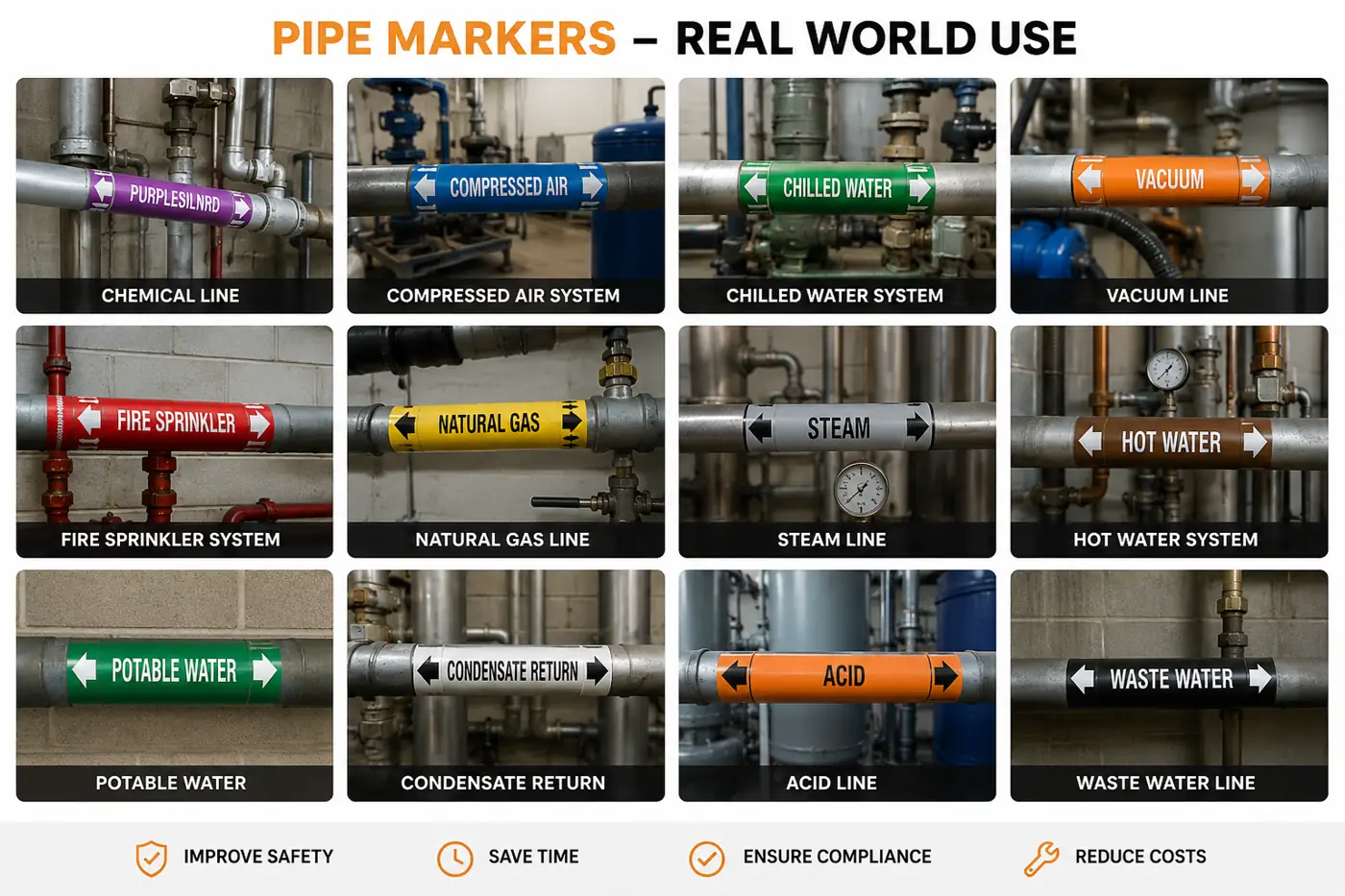
Below are some commonly used pipe marker colours found in industrial and commercial facilities throughout New Zealand.
Green Pipe Markers – Water Services
Green is commonly used to identify water-related services such as:
- Potable water
- Cold water
- Chilled water
- Cooling water
Green pipe markers are commonly seen in:
- Commercial buildings
- Schools
- Plant rooms
- Processing facilities
Red Pipe Markers – Fire Services
Red pipe markers are commonly used for:
- Fire sprinkler systems
- Fire hydrant lines
- Fire protection services
These markers help emergency services and maintenance personnel quickly identify critical fire infrastructure.
Yellow Pipe Markers – Hazardous or Flammable Services
Yellow is often used for:
- Gas lines
- Flammable services
- Hazardous pipe contents
Common examples include:
- LPG
- Natural gas
- Fuel gas systems
Blue Pipe Markers – Compressed Air
Blue pipe markers are commonly used to identify:
- Compressed air systems
- Pneumatic lines
- Workshop air services
These are especially common in:
- Engineering workshops
- Factories
- Automotive facilities
- Manufacturing plants
Orange Pipe Markers – Dangerous or Toxic Services
Orange may be used for:
- Toxic chemicals
- Dangerous substances
- Chemical transfer systems
These are often found in:
- Chemical processing plants
- Industrial manufacturing
- Agricultural facilities
Silver or Grey Pipe Markers – Steam Systems
Steam lines are often identified using:
- Silver
- Grey
- Aluminium-style markers
Steam systems are common in:
- Boiler rooms
- Food processing plants
- Industrial heating systems
Why Flow Direction Arrows Matter
Many pipe markers include directional arrows showing the direction of flow.
Flow arrows are extremely important because they:
- Assist maintenance staff
- Improve fault finding
- Help emergency responders
- Reduce servicing errors
Flow direction arrows should be clearly visible and positioned consistently throughout the site.
Where Should Pipe Markers Be Installed?
Pipe markers should be installed:
- Near valves
- At wall penetrations
- At changes in direction
- At regular intervals
- Near access points
- Wherever visibility is important
Markers should remain visible from normal approach angles and viewing distances.
Choosing the Right Pipe Marker Size
The correct pipe marker size depends on:
- Pipe diameter
- Viewing distance
- Lighting conditions
- Installation height
Larger facilities often require oversized markers for visibility across plant rooms or production areas.
Smaller workshops or confined plant spaces may only require compact pipe labels.
Custom Pipe Markers
Many facilities require custom pipe markers for:
- Site-specific terminology
- Special services
- Unique pipe systems
- Additional safety instructions
Custom pipe markers can include:
- Custom wording
- Direction arrows
- Site colours
- Hazard warnings
- Company-specific identification systems
Pipe Markers for NZ Workplaces
At Hazard Signs NZ, we supply durable pipe markers suitable for:
- Industrial facilities
- Commercial buildings
- Factories
- Workshops
- Dairy farms
- Processing plants
- Schools
- Hospitals
- Warehouses
Our pipe identification labels are designed for long-term indoor and outdoor use and can be customised to suit your site requirements.
Related Products
- Compressed Air Pipe Markers
- Water Pipe Markers
- Fire Service Pipe Markers
- Gas Pipe Markers
- Steam Pipe Markers
- Custom Pipe Identification Labels
| Colour | Common Service | Typical Use |
|---|---|---|
| Green | Water | Potable & cooling water |
| Blue | Compressed Air | Pneumatic systems |
| Red | Fire Services | Sprinkler systems |
| Yellow | Gas | Flammable services |
| Orange | Hazardous Chemicals | Dangerous substances |
| Grey/Silver | Steam | Boiler & heating systems |
Frequently Asked Questions
What standard applies to pipe markers in New Zealand?
AS/NZS 1345 provides guidance for identifying the contents and direction of flow in industrial and commercial pipe systems.
Why do pipe markers use different colours?
Different colours help workers quickly identify the type of service within a pipe, improving safety and maintenance efficiency.
Do pipe markers require directional arrows?
Directional arrows are strongly recommended because they help indicate flow direction and improve maintenance and emergency response.
Can pipe markers be customised?
Yes — custom pipe markers can be produced with specific wording, colours, arrows, and sizing to suit your facility requirements.
Where should pipe markers be installed?
Pipe markers should be installed near valves, wall penetrations, direction changes, and at regular intervals along visible pipework.
Got pipes running everywhere like spaghetti in a plant room? Our Pipe Markers help stop the guessing game before someone shuts off the wrong line.
Shop Pipe Markers NZ
We supply:
- Water pipe markers
- Gas pipe markers
- Fire service markers
- Compressed air labels
- Steam pipe markers
- Acid Pipe markers
Available in multiple sizes with optional directional flow arrows.